
Power: the right size, not the biggest

You don't need a whole-home generator. You need enough power to charge phones, run a few lights, keep essential medical devices going, and maybe save the fridge. Here's how to pick the right tier without overspending on capacity you'll never use.

Heads up: Some links below are affiliate links. If you buy through them we may earn a small commission at no extra cost to you. Full disclosure →

Three tiers. Pick the one that matches your risk.

Your outage history determines your tier. "The power flickers a few times a year" is a different problem from "we lose power for a week every winter."

  • Tier 1 — Phone-bank: 20,000 mAh USB battery + a headlamp. Covers 2–4 short outages.
  • Tier 2 — Room power: 500–1,000 Wh portable power station. Runs lights, phones, router, CPAP for a night or two.
  • Tier 3 — Fridge power: 1,500–2,500 Wh power station with solar input. Keeps a full-size fridge alive for 24–48 hours per charge.
20,000 mAh USB-C battery pack with digital display.
Tier 1 · Best budget

20,000 mAh USB-C Power Bank

Four full iPhone charges. Charges itself in 2 hours from a wall outlet. Pocketable.

Pros

  • Under $40 for a good one
  • Charges phones, tablets, headlamps
  • Small enough to always be packed

Cons

  • Won't run a light bulb or appliance
  • Limited to low-watt USB devices
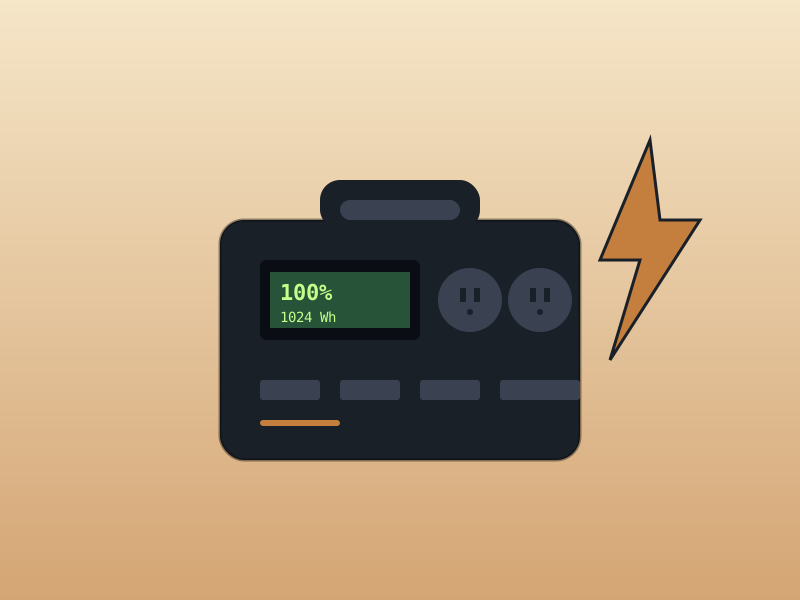
Portable power station with AC outlets and LCD display.
Tier 2 · Best all-around

Jackery / EcoFlow 500–1,000 Wh Power Station

One night of lights, phones, router, and a CPAP with room to spare. The 80/20 answer for most homes.

Pros

  • Multiple AC, USB, and 12V outputs
  • Quiet — safe to run indoors (no fumes)
  • Recharges from wall or optional solar

Cons

  • Won't run a full-size fridge for more than a few hours
  • Heaviest units are 20+ lb
Large capacity power station with solar panel connected.
Tier 3 · Best for long outages

2,000+ Wh Power Station with Solar Input

Keeps a fridge alive for a day on a charge. Recharges from sun if the grid stays down.

Pros

  • Real fridge-runtime capacity
  • Solar-ready — outage doesn't mean countdown clock
  • Powers medical devices for days

Cons

  • 40+ lb — plan a wheeled cart
  • Large price jump vs. Tier 2

Don't forget the boring stuff

  • A headlamp per person (not a handheld flashlight — hands-free changes everything).
  • A box of long-life AA and AAA batteries for radios and smoke detectors.
  • A USB-C car charger — if you own a car, you already own a 12V generator.

Never run a gas generator indoors

If you buy a fuel-burning generator, it goes outside — at least 20 feet from any door or window, facing away from the house. Carbon-monoxide poisoning kills more people during outages than the outages themselves. A portable lithium power station is safe indoors; a gas generator is not.

Related reading